Winning starts long before competition day—with the rulebook, the team and steady testing
A practical guide for Indian schools, parents and students on preparing for robotics competitions—choosing the right event, building a team, an 8–10 week plan and competition-day tips.
Introduction
Robotics competitions give students a real deadline, a real arena and real judges. A good experience rarely depends on the most expensive kit. It depends on steady preparation, a team that works well together and a clear understanding of the rules.
This guide is for principals, teachers, parents and students in roughly Classes 5 to 12. It covers choosing a competition, forming a team, a sample timeline, building, documentation, competition day and support on a budget.
Why robotics competitions are worth it
Teamwork. Students learn to divide work, share credit and resolve disagreements under time pressure.
Problem solving. A robot that works on the classroom floor may fail on the arena. Finding out why, and fixing it quickly, is real engineering.
Confidence. Explaining a design to judges builds communication skills. Competitions also fit well with the experiential learning that NEP 2020 encourages.
Common types of robotics competitions
Formats vary between organisers, but most fall into a few broad types.
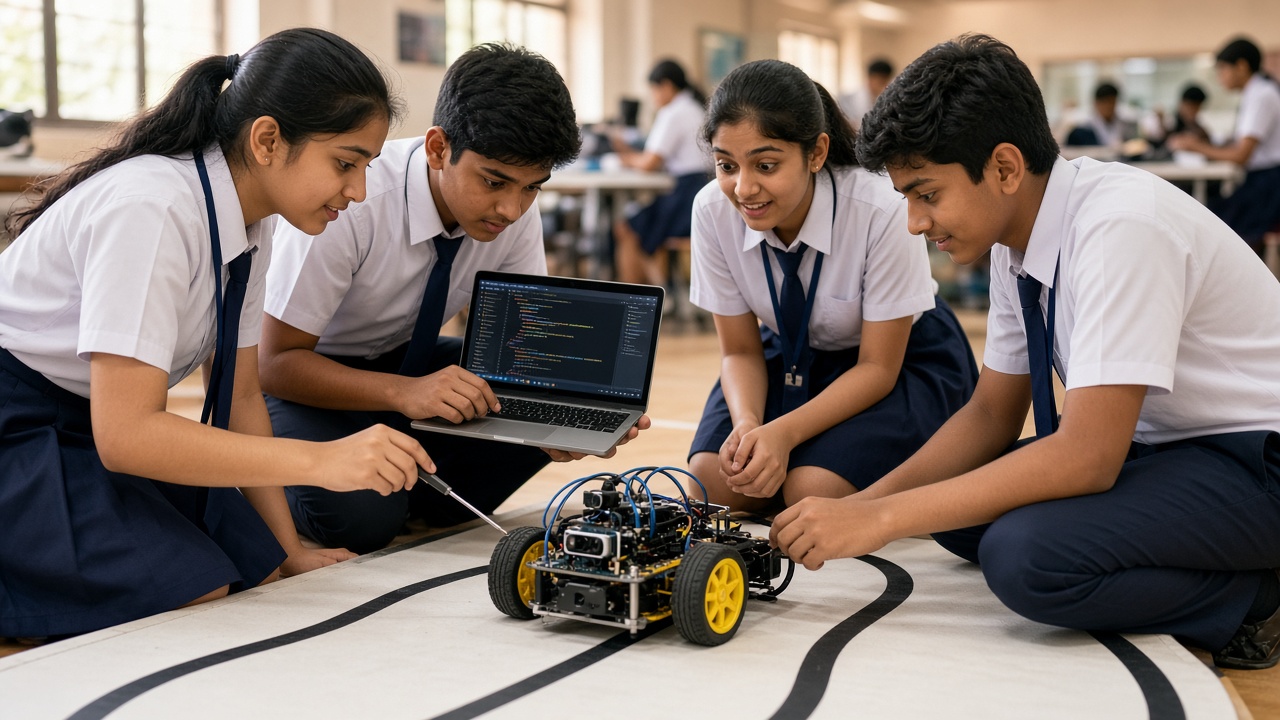
Line-following. The robot follows a marked track, often with curves or junctions, quickly and accurately.
Obstacle and maze challenges. The robot uses sensors to avoid obstacles or find its way through a maze.
Pick-and-place tasks. The robot moves objects to target zones, testing mechanical design and precise control.
Innovation and project showcases. Teams present a robot that solves a real-world problem, and judges assess the idea, design and explanation.
Online coding and robotics challenges. Students program virtual robots or simulations, a low-cost entry point for schools with little hardware.
How to pick the right competition
Read the official rulebook first. Rules decide robot size and weight limits, power sources, scoring, time limits and penalties. Download the latest version from the organiser, as rules can change between seasons.
Check the age category. Make sure your team fits the category and the challenge suits their current skills.
Confirm team size. Note the allowed number of members and whether a mentor must register.
Look for kit restrictions. Some events allow only certain platforms or kits. Check before buying anything.
Forming a team and assigning roles
Teams of three to five usually work well. Include students who are curious and willing to learn, not only those who already code.
Useful roles include builder (mechanical design and assembly), programmer (writing and debugging code), tester (running trials and recording results), documenter (keeping the engineering notebook) and presenter (leading the explanation to judges). Rotate tasks during practice so everyone understands the whole robot.
A sample 8–10 week preparation timeline
Weeks 1–2: Understand and plan. Study the rulebook, list scoring tasks, sketch designs and order parts early.
Weeks 3–4: First build. Build a basic robot that completes the simplest task, even if it looks rough.
Weeks 5–6: Add features and test. Work on sensors, attachments and code for harder tasks, testing after every change.
Weeks 7–8: Refine. Improve reliability and run timed practice rounds in the competition format.
Weeks 9–10: Freeze and rehearse. Stop major changes, finish documentation and rehearse the presentation.
If you have less time, shorten each stage but keep the final freeze-and-rehearse week.
Building and testing the robot
Iterate in small steps. Get one function working, then add the next. Save each working version of the code so you can go back if a change breaks something.
Test on a mock arena. Recreate the arena as the rules describe, using chart paper, electrical tape or cardboard. Lighting and surfaces affect sensors, so test in different conditions.
Carry spare parts. Keep extra wires, screws, wheels, sensors and basic tools.
Manage batteries carefully. Label and fully charge batteries, and note how performance changes as charge drops. Use only the battery type the rules allow, and charge under adult supervision.
The engineering notebook and presenting to judges
Many competitions ask teams to explain their process, and some score documentation. An engineering notebook records ideas, sketches, decisions, test results, problems and fixes. Date every entry and add photos.
When presenting, keep it simple: the challenge, your design, the biggest problem you faced and how you solved it, and what you would improve. Every team member should be able to answer basic questions about the robot. Judges often value honest reasoning more than polished scripts.
Competition-day checklist
Pack the robot in a padded box, with charged batteries and a charger, spare parts, tools, a laptop with the latest code and a backup copy on a pen drive, cables, the engineering notebook, registration documents, water and snacks. Arrive early, inspect the arena and calibrate sensors for the venue's lighting if the rules allow it.
Handling failure and sportsmanship
Robots often fail in ways the team never saw in practice. A failed round is a chance to diagnose calmly, fix what they can and try again.
Encourage students to respect referees, cheer for other teams and learn from strong designs. Afterwards, hold a short review: what worked, what didn't and what to try next time.
Supporting students on a budget
Schools can share kits across teams, reuse components from earlier projects and practise coding in free simulators before buying hardware. Mock arenas can be made from low-cost materials. Parents can help most by giving steady time and encouragement, not by doing the work for their children. Begin with a school-level or online challenge before committing to larger events.
Frequently asked questions
Q: What is the right age to start robotics competitions? A: Many students begin around Classes 5 to 7 with beginner categories, but readiness matters more than age.
Q: Do we need an expensive robotics kit? A: Not always. Check the rulebook first. Many beginner challenges can be attempted with basic kits or simulators.
Q: How much time should students practise each week? A: It varies. Regular weekly sessions over several weeks usually work better than last-minute cramming.
Q: What if our robot fails on the day? A: Treat it as learning. Record what went wrong and use it to prepare better for the next event.
Prepare for competitions with SheepByte
SheepByte is an AI and robotics education company based in Udaipur, Rajasthan. We work with schools and students through our AI Learning, Coding Bootcamp, Drone Technology, Innovation Club, Robotics Lab and STEM Integration programs. We run workshops in Jaipur, Delhi and online, and help schools set up robotics labs.
If your students want to take part in robotics competitions, ask us about Robotics Lab setup, starting an Innovation Club, our Coding Bootcamp or hands-on workshops. Email support@sheepbyte.com or visit sheepbyte.com.