Fair, honest and safe: how to use AI responsibly, explained simply for students, parents and school leaders
A beginner-friendly guide to AI ethics for Indian schools: what AI ethics means in simple words, fairness and bias, privacy and personal data, honest use of AI for homework, deepfakes and misinformation, safety and responsibility, classroom activities and discussion questions, and how parents and teachers can guide students.
Introduction
AI is now part of everyday life for many students in India. It suggests videos, answers questions and even helps write essays. Because AI is powerful, we also need to ask: is it being used fairly, honestly and safely? That question is what AI ethics is about. This guide explains AI ethics in simple words for students in Classes 6 to 12, with classroom activities and tips for parents and teachers.
What does AI ethics mean?
AI ethics is the study of right and wrong in how artificial intelligence is designed, built and used. It asks questions such as: Is this AI fair to everyone? Does it respect people's privacy? Is it being used honestly? Who is responsible if it makes a harmful mistake?
AI ethics is not only for scientists. Anyone who uses a chatbot, shares an AI-made image or builds a school AI project is making ethical choices.
Fairness and bias
AI systems learn patterns from data. If the data is unfair, incomplete or one-sided, the AI can repeat those problems. This is called bias. For example, a face recognition system trained mostly on photos of one group of people may work less well for others. A tool trained mostly on English text may give weaker results in Indian languages.
Bias is usually not deliberate, but it can still cause real harm. Students can spot bias by asking: Who is missing from this data? Does the result work equally well for everyone? Learn more about how AI sees images at sheepbyte.com/blog/what-is-computer-vision-explained-school-students.
Privacy and your data
Many AI tools collect what you type, upload or say. Personal data includes your name, photos, phone number, address, school, location and even your voice. Once shared online, it can be hard to take back.
India's Digital Personal Data Protection Act, 2023 sets rules for how organisations handle personal data, including extra care for children's data. Its rules are being put in place in stages and India's approach to AI is still evolving, so check official sources for the latest. Whatever the rules, a simple habit helps: do not share anything with an AI tool that you would not want a stranger to see.
Honesty: using AI for homework
AI chatbots can explain a tough maths concept, quiz you before a test or suggest ideas for a project. Used this way, AI is a helpful study partner. But copying an AI-written answer and submitting it as your own is dishonest, just like copying from a friend. It also means you miss the learning.
Good rules for students: follow your school's and teacher's rules on AI; use AI to understand, not to replace your thinking; tell your teacher when you have used AI; and always check AI answers, because chatbots can state wrong facts confidently. For more on how chatbots work, read sheepbyte.com/blog/what-is-generative-ai-explained-for-school-students.
Deepfakes and misinformation
A deepfake is a fake video, photo or voice recording made with AI to look or sound like a real person. Deepfakes and AI-written fake news can spread quickly on social media and messaging apps.
Before you forward something, pause and ask: Who made this? Is a trusted news source reporting it? Does anything look or sound odd? Never create or share fake images or videos of classmates, teachers or anyone else. It can hurt people deeply and may be against the law. In India, cyber crimes can be reported on the National Cyber Crime Reporting Portal at cybercrime.gov.in or through the helpline 1930.
Safety and responsibility
Many AI apps have minimum age rules, so check their terms and use them with a parent's permission. If a chatbot says something upsetting, asks for personal details or encourages anything unsafe, stop and tell a trusted adult.
Responsibility also applies to builders. Students building AI projects should think about who might be harmed, test with different users and be open about limits. AI should support human decisions, not replace human care and judgement.
Classroom activities and discussion questions
Classes 6 to 8: Play "Fair or Unfair?". Give small groups simple scenario cards, such as an app that recommends only cricket videos to boys and only cooking videos to girls. Groups decide whether it is fair and suggest a fix.
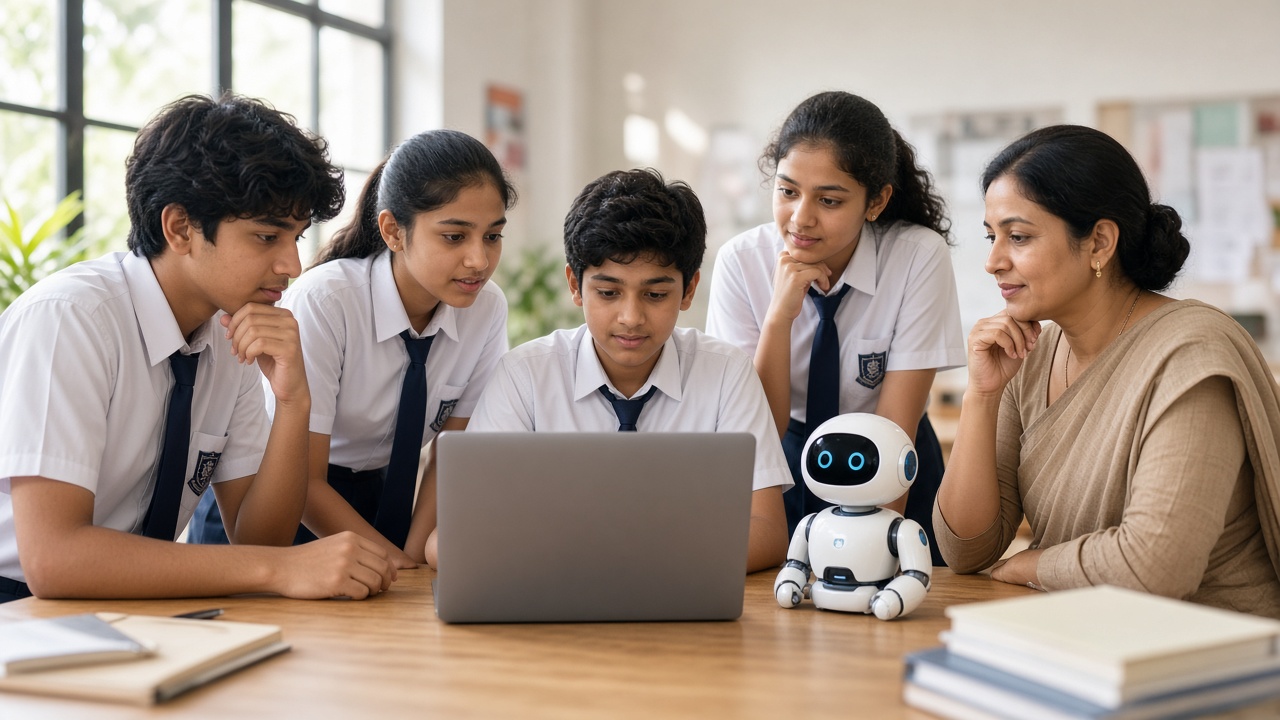
Classes 9 to 12: Hold a class debate on "Should students be allowed to use AI for homework?" or ask groups to write a one-page AI code of conduct for their school. Older students can also train a simple model with a free tool such as Teachable Machine, using an unbalanced dataset first, and observe how the results change.
Discussion questions: Who should be responsible when AI makes a mistake? Should AI ever make decisions about people without a human checking? What information would you never share with a chatbot, and why?
How parents and teachers can guide kids
Parents: Explore AI tools with your child, talk openly about what they use, and set simple family rules on privacy. Ask your child to explain what they learned from AI, not just show the answer.
Teachers: Make your AI policy clear for each assignment, design tasks that value process, such as drafts, reflections and oral explanations, and include short ethics discussions in computer, science and social science lessons. Some school boards, including CBSE, have introduced AI-related content at certain levels, but curricula change, so check the latest official guidelines.
Frequently asked questions
Q: Is it wrong to use AI for homework? A: Not always. Using AI to understand a topic can be helpful. Submitting AI-written work as your own, or breaking your school's rules, is not okay.
Q: Can AI be completely fair? A: It is very hard. People can reduce bias with better data, testing and human checks, but they need to keep watching for it.
Q: At what age should children learn about AI ethics? A: Simple ideas such as fairness, privacy and honesty can start as soon as children begin using digital tools, with deeper discussion in middle and senior school.
Learn responsible AI with SheepByte
SheepByte is an AI and robotics education company based in Udaipur, Rajasthan. Our AI Learning and Coding Bootcamp programmes help students understand how AI works and how to use it responsibly through hands-on projects, and our Robotics Lab, Drone Technology, Innovation Club and STEM Integration programmes connect technology with real-world problem-solving. We run workshops in Jaipur, Delhi and online, and we help schools set up robotics labs.
If you want to bring hands-on, responsible AI learning to your school or child, write to support@sheepbyte.com or visit sheepbyte.com.