Cameras, radar, lidar and AI: how driverless cars sense, think and act, explained simply for students and parents, with robot projects to try
A beginner-friendly guide to how self-driving cars work for Indian school students and parents: the sense-think-act loop, the main sensors (cameras, radar, lidar, ultrasonic and GPS), AI perception and prediction, mapping and localisation, planning and control, the levels of driving automation, why Indian roads are especially challenging, safety and ethics, and simple robot projects students can build.
Introduction
Imagine a car that drives you to school while you read a book. Self-driving cars, also called autonomous vehicles, are being tested in several countries, and they combine robotics, sensors and artificial intelligence. The main ideas are simple enough to understand, and even to try with a small robot. This guide explains them step by step for students in Classes 6 to 12 and their parents.
What is a self-driving car?
A self-driving car is a vehicle that can sense its surroundings, understand what is happening and drive itself with little or no human help. It follows the same sense-think-act loop as every robot: sensors collect information, AI software decides what to do, and motors control the steering, accelerator and brakes.
The sensors: a car's eyes and ears
No single sensor is perfect, so most self-driving cars combine several types:
Cameras: read traffic lights, road signs and lane markings, but can struggle in darkness, glare or heavy rain. Radar: uses radio waves to find how far away objects are and how fast they are moving, and works well in fog and rain. Lidar: short for light detection and ranging, it times laser pulses bouncing back to build a detailed 3D picture of the surroundings. Ultrasonic sensors: use sound waves to detect very close objects, as in parking sensors. GPS: tells the car roughly where it is, often to within a few metres.
Combining these readings is called sensor fusion. Our guide at sheepbyte.com/blog/robot-sensors-beginners-guide-school-students explains individual sensors in more detail.
Perception: how AI makes sense of the world
Raw sensor data is just numbers. Perception turns those numbers into meaning: that is a pedestrian, that is a bus, that light is red. Much of this uses computer vision and machine learning, where the AI is trained on large collections of labelled images until it can recognise similar objects in new situations.
Perception also involves prediction. Will that cyclist turn? Is that child about to step off the footpath? Learn how computers see images at sheepbyte.com/blog/what-is-computer-vision-explained-school-students.
Mapping and localisation: where exactly am I?
GPS alone is usually not precise enough to keep a car inside its lane. Many self-driving systems therefore use detailed maps of lanes, kerbs and signs, and compare what the sensors see with the map to work out the car's exact position. This is called localisation. Motion sensors help in tunnels, where GPS signals are weak.
Planning and control: deciding and doing
Next, planning software decides what to do. Route planning chooses the overall path, like a maps app. Behaviour planning decides when to change lanes, stop or overtake. Motion planning works out a smooth, safe path for the next few seconds.
The control system then adjusts steering, speed and braking many times every second, and the whole loop keeps repeating as the scene changes.
Levels of driving automation
Not every car with smart features is self-driving. SAE International, an engineering standards organisation, describes six levels of driving automation. In simple terms:
Level 0: the driver does everything, though the car may give warnings. Level 1: the car helps with either steering or speed, such as adaptive cruise control. Level 2: the car controls steering and speed together in some situations, but the driver must watch the road at all times. Level 3: the car drives itself in certain conditions, but a human must take over when asked. Level 4: the car drives itself without a human, but only within a limited area or conditions. Level 5: the car drives itself anywhere a human driver could.
Some newer cars sold in India offer driver-assistance features, such as automatic emergency braking or lane-keeping help, which belong to the lower levels and still need an alert driver. Rules for self-driving vehicles differ between countries and are still developing in India, so check official sources for the current position.
Why Indian roads are especially challenging
Many self-driving systems were first developed on roads with clear markings and fairly predictable traffic. On one Indian street you might see cars, buses, auto-rickshaws, two-wheelers, bicycles, handcarts and pedestrians, all moving differently. Lane markings may be faded or missing, signs can vary, and cows, dogs or goats sometimes walk onto the road. Potholes, monsoon waterlogging and dust add to the difficulty. That is why systems need training data from local roads and careful testing.
Safety and ethics
Supporters hope self-driving technology can reduce accidents caused by human mistakes such as distraction. But machines make mistakes too, especially in rare situations, so careful testing and clear rules matter.
There are ethical questions too. Who is responsible if a self-driving car causes an accident? How should camera footage and location data be protected? How will people who earn a living by driving be affected? These make great class debate topics, and our guide at sheepbyte.com/blog/ai-ethics-for-school-students-guide-india can help.
Explore the ideas with simple projects
You do not need a real car to learn how self-driving works:
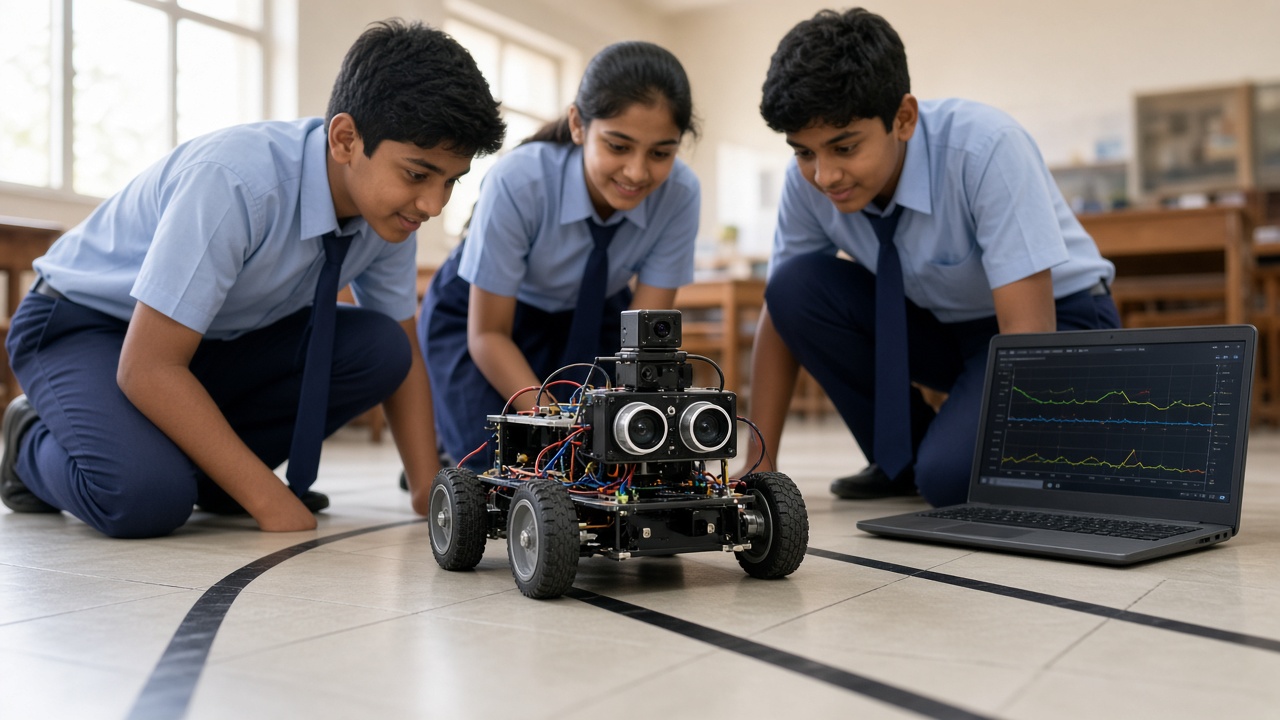
Line-following robot: infrared sensors under a small robot detect a black line, and the code steers the motors to stay on track, a mini version of lane keeping. Obstacle-avoiding robot: an ultrasonic sensor measures distance, and the robot stops or turns when something gets too close, just as cars detect objects and brake. Basic image recognition: with a free beginner tool such as Teachable Machine, train a model to recognise a toy car, a hand-drawn stop sign and an empty road.
A robot combining all three makes a strong science exhibition project. Find more ideas at sheepbyte.com/blog/beginner-robotics-project-ideas-for-students.
Frequently asked questions
Q: Can I buy a fully self-driving car in India? A: Some cars offer driver-assistance features, but these still need a human driver in control. Rules on fully driverless cars are still developing, so check official sources.
Q: What should I study to work on self-driving cars? A: Mathematics, physics and computer science help, along with coding, electronics, robotics and machine learning. School robotics and AI projects are a great first step.
Start your self-driving journey with SheepByte
SheepByte is an AI and robotics education company based in Udaipur, Rajasthan. In our Robotics Lab programme, students build and program robots with real sensors, and in our AI Learning programme they explore how machines recognise images and make decisions. We also run Coding Bootcamp, Drone Technology, Innovation Club and STEM Integration programmes, set up school robotics labs, and run workshops in Jaipur, Delhi and online.
To help your school or child build a first line-following or obstacle-avoiding robot, write to support@sheepbyte.com or visit sheepbyte.com.