Joints, motors, sensors and a lot of clever code: a plain-language look at how robots built like people stand, walk and respond, for students in Classes 6 to 12
A beginner-friendly guide to humanoid robots for Indian school students, parents and teachers: what a humanoid robot is and how it differs from robotic arms, wheeled robots and drones, the body with links, joints, actuators such as servo motors and degrees of freedom, sensors including cameras, IMUs with gyroscopes and accelerometers, touch and force sensors and microphones, the controller, software and AI for vision and speech, why walking and balance are so hard, examples such as Honda's ASIMO, Boston Dynamics' Atlas and ISRO's Vyommitra for Gaganyaan, myths versus reality, a balance experiment and cardboard servo arm activity, careers and FAQs.
Introduction
Films love robots that look and move like people. Real humanoids exist too, and they are a brilliant mix of mechanics, electronics and code. This guide explains it simply for students in Classes 6 to 12 and the parents and teachers helping them.
What is a humanoid robot?
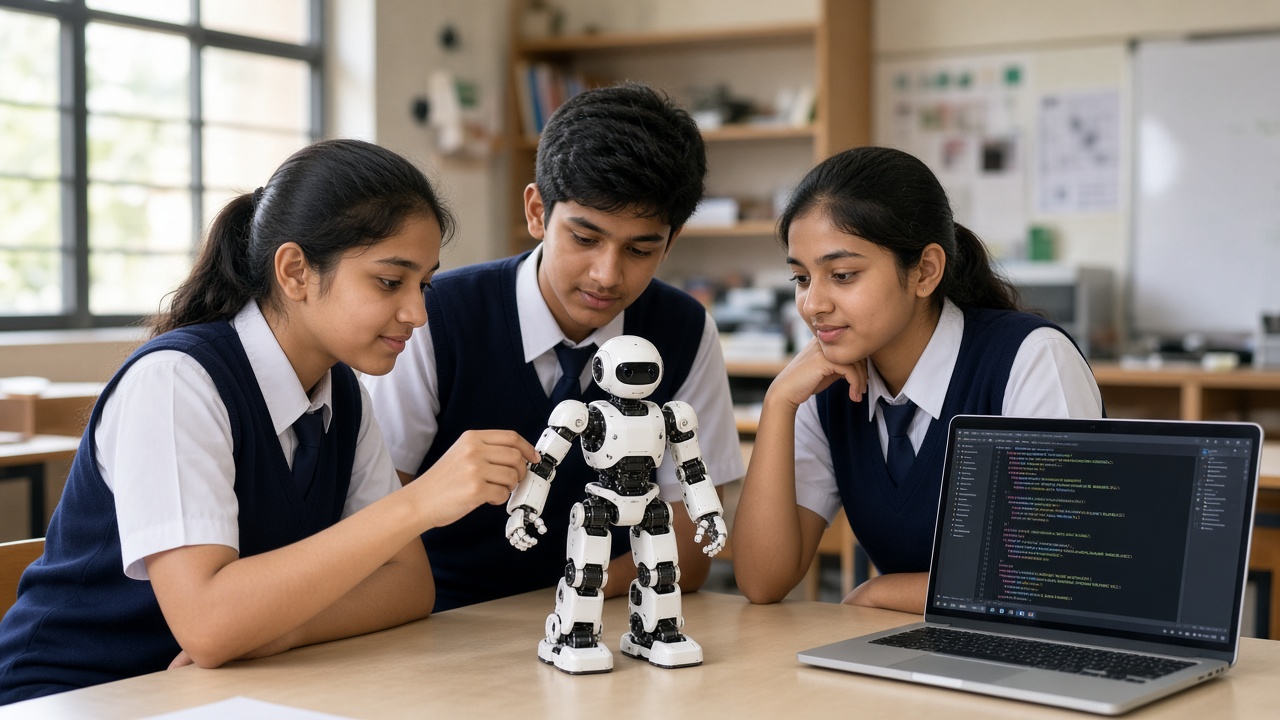
A humanoid robot is a robot whose body is shaped roughly like a human, usually with a head, a torso, two arms and often two legs, so it can move and work in a world built for people.
That shape is the main difference from other robots. A factory robotic arm is fixed in one place, a line follower rolls on wheels and a drone flies. A humanoid tries to do what we do: climb stairs, open doors and use ordinary tools. Some, like ISRO's Vyommitra, have only an upper body and are still called humanoids or half-humanoids.
The body: joints, actuators and degrees of freedom
A humanoid's skeleton is made of rigid parts called links, joined at joints such as the shoulder, elbow, hip, knee and ankle.
Each joint is moved by an actuator. Small hobby and school humanoids use servo motors, which turn to a precise angle when told to. Larger research robots use powerful electric motors with gearboxes, and some older designs used hydraulics, where pressurised fluid pushes pistons.
Every joint that can move on its own adds one degree of freedom, or DOF. A small kit humanoid often has a dozen or more servos. More DOF means more natural movement, but more to control. Our guide at sheepbyte.com/blog/how-robotic-arms-work-guide-school-students-india explains joints and servos in more detail.
Sensors: how a humanoid feels the world
Cameras act as eyes, helping the robot spot objects, people and obstacles.
An IMU, or inertial measurement unit, combines a gyroscope and an accelerometer. It tells the robot if it is tilting or falling, much like the balance organs in your inner ear.
Force sensors in the hands and feet show how hard it grips and how its weight is spread. Microphones let it hear voice commands, and encoders in each joint report the exact angle. For more on these parts, read sheepbyte.com/blog/robot-sensors-beginners-guide-school-students.
The brain: controllers, software and AI
All that sensor data goes to the robot's computer. Small robots may use an Arduino with a servo driver; bigger ones carry powerful onboard computers.
Software runs a fast loop: read sensors, decide, command the motors, repeat, many times a second.
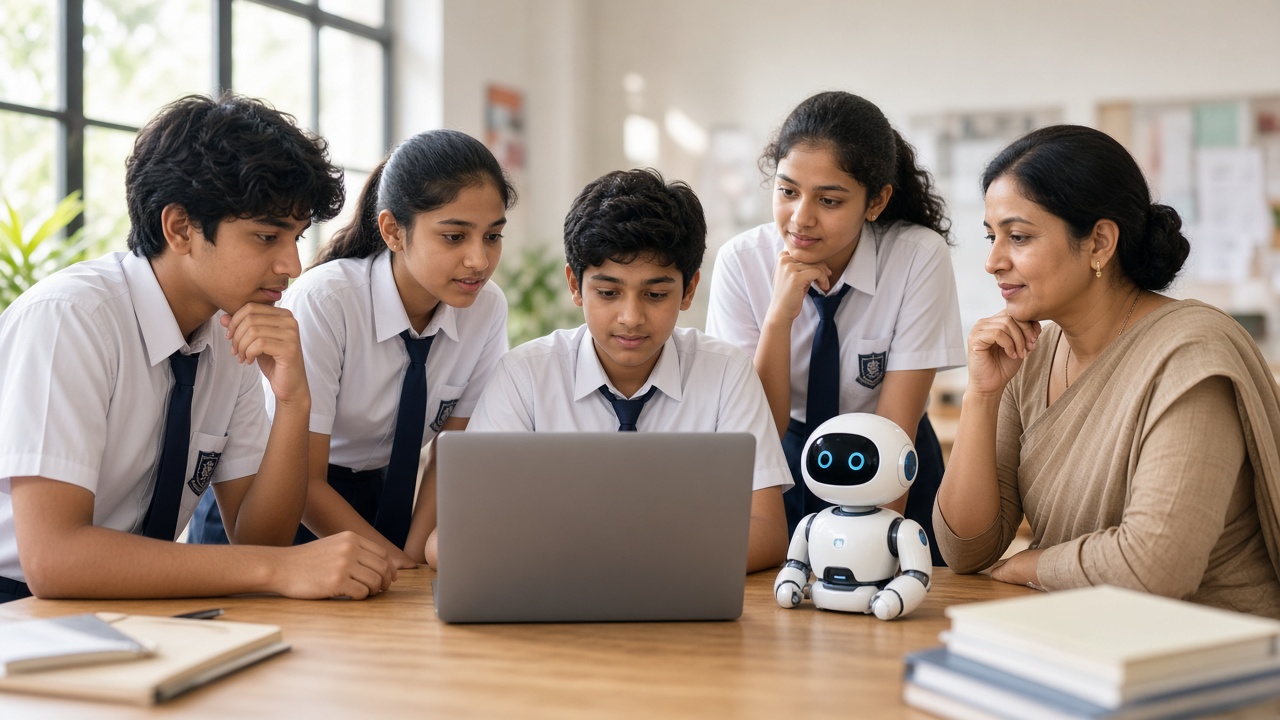
AI adds higher-level skills. Computer vision helps it recognise faces and objects, speech recognition and language models let it understand and reply to people, and machine learning can help it learn movements, often first in computer simulations.
Why walking and balance are so hard
Stand on one leg and feel your body making tiny corrections. A robot has to calculate all of them.
To stay upright, a robot must keep its centre of mass over the area its feet cover. When it walks, it is briefly on one foot, which is a controlled fall. It must read the IMU and foot sensors, predict where its weight is going and adjust its ankles, knees and hips in fractions of a second. Add uneven floors or a slippery tile, and you see why wheels are often more practical.
Real humanoid robots
Honda's ASIMO was one of the best-known humanoids for many years and showed a robot could walk and climb stairs. Honda has since retired it.
Boston Dynamics, a US company, has shared videos of its Atlas robot running, jumping and even doing flips. Its newer versions are electric and aimed at more practical work.
In India, ISRO has developed Vyommitra, a female-looking half-humanoid. ISRO has said it is meant to fly on uncrewed Gaganyaan test missions to monitor systems and test conditions before astronauts go up. Mission plans and timelines can change, so check ISRO's official updates.
Myths and reality
Myth: humanoids think and feel like humans. Reality: they follow programs and learned patterns. They have no feelings, even if a friendly face makes it seem so.
Myth: humanoid robots will soon do all household chores. Reality: several companies are testing humanoids for jobs like moving boxes in warehouses, but folding clothes, cooking or tidying a messy room is still very hard for them.
Reality: humanoids are improving quickly, though, and need skilled people to build them.
Classroom activity: balance and a cardboard servo arm
Balance experiment: stand on one foot with your eyes open for 30 seconds, then try with eyes closed. It gets harder without visual information, just as robots struggle when a sensor gives poor data. Next, stand up a ruler with a small lump of clay on top, then try with the clay at the bottom. Discuss where the centre of mass is and why it matters for a walking robot.
Cardboard arm: cut cardboard strips for an upper arm and forearm, join them at the elbow with a split pin, and mount a micro servo at the shoulder. With an Arduino, the Servo library and a few lines of code, the arm can wave. Older students can add an elbow servo. Always use a separate battery pack for several servos and ask a teacher to check the wiring.
Careers and next steps
Humanoid robotics combines mechanical engineering, electronics, computer science, AI and even biology. Start with basic electronics, Arduino or micro:bit projects and Python, then build up to sensors and control. sheepbyte.com/blog/careers-ai-robotics-after-class-12-india explains the paths after Class 12.
Frequently asked questions
Q: Can school students build a humanoid robot? A: Yes, a small one. Kit humanoids with servos can walk slowly and dance.
Q: Is a humanoid robot the same as AI? A: No. The robot is the physical machine. AI is software that can help it see, hear and decide, but many robots run on simpler code.
Q: Why build robots shaped like humans at all? A: Our homes, offices and tools are designed for human bodies, so a human-shaped robot could, in theory, fit in without changing them.
Build real robots with SheepByte
SheepByte is an AI and robotics education company based in Udaipur, Rajasthan, working with schools and students. Our programmes include AI Learning, Coding Bootcamp, Drone Technology, Innovation Club, Robotics Lab and STEM Integration, all built around making real projects. We also set up robotics labs in schools and run workshops in Jaipur, Delhi and online.
To bring hands-on robotics, from servo arms to walking robots, to your school or help your child get started, write to contact@sheepbyte.com or call or WhatsApp +91 75975 60225.