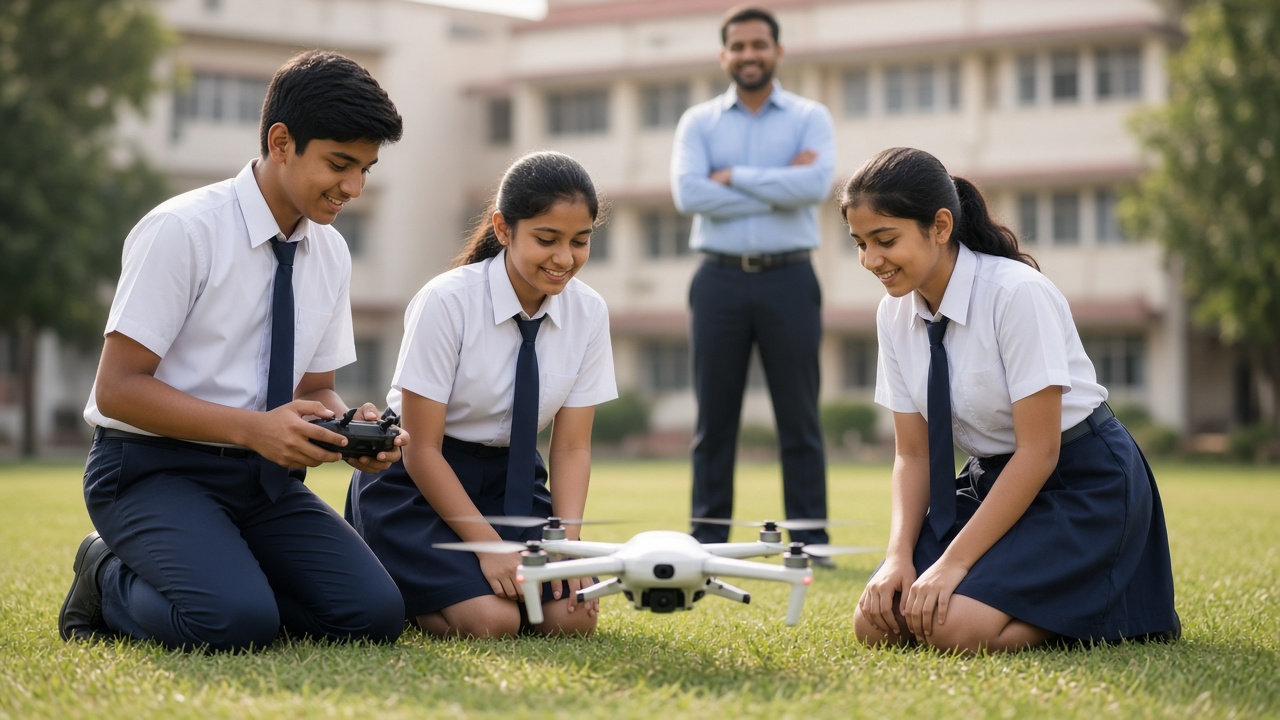
No wings to flap and no pilot on board: a plain-language look at the science that keeps a drone in the air, for students in Classes 6 to 12
A beginner-friendly guide to how drones fly for Indian school students, parents and teachers: what a drone is, lift, thrust and the four forces, how propellers and brushless motors create push, how quadcopters climb, turn and move by varying rotor speeds with opposite spin directions for yaw, pitch and roll, how the flight controller uses a gyroscope, accelerometer, barometer and GPS, batteries and flight time, remote control, simple hands-on activities, safety and India's Drone Rules 2021 and Digital Sky, and links to coding and careers.
Introduction
A drone hovers above a cricket ground, then zips sideways to follow the ball. It has no pilot inside, yet it stays in the air. How? This guide explains how drones fly in plain language for students in Classes 6 to 12, and for the parents and teachers helping them learn.
What is a drone?
A drone is an aircraft with no pilot on board. It is flown by remote control or by a computer following a planned route. Engineers call it an unmanned aerial vehicle, or UAV.
Some drones have fixed wings like small aeroplanes, but the kind you see most at weddings, farms and school clubs is the quadcopter, which has four propellers. This guide focuses on quadcopters.
Lift, thrust and the four forces
Every flying thing deals with four forces. Weight is gravity pulling the drone down. Lift is the upward push that holds it up. Thrust moves it forward. Drag is air resistance that slows it down.
An aeroplane gets lift from its wings and thrust from its engines. In a quadcopter, the propellers do both jobs. They push air downwards, and the air pushes the drone upwards, which is Newton's third law in action. If that push is bigger than the weight, the drone climbs. If they are equal, it hovers.
Propellers and motors
A propeller's blades are twisted and angled so that, as they spin, they push air down. The faster they spin, the more push they create.
Most quadcopters use brushless electric motors, which are light, powerful and quick to change speed. A small circuit called an electronic speed controller (ESC) tells each motor exactly how fast to spin.
How a quadcopter climbs, turns and moves
A quadcopter has no rudder or flaps. It steers only by changing each rotor's speed.
Two propellers spin clockwise and two anticlockwise, in diagonal pairs. Each spinning propeller tries to twist the drone the opposite way, so with two each way the twists cancel out.
Climbing and descending: all four motors speed up together to rise and slow down together to come down. Yaw (turning on the spot): one diagonal pair speeds up while the other slows, so the twisting no longer balances and the drone rotates. Pitch (tilting forward or back): the rear motors spin faster than the front ones, the nose dips, and part of the push now points backwards, so the drone moves forward. Roll (tilting sideways): the motors on one side spin faster, the drone leans, and it slides the other way.
The flight controller and its sensors
No human could adjust four motors many times every second. That job belongs to the flight controller, a small computer that acts as the drone's brain.
A gyroscope measures how fast the drone is rotating, and an accelerometer senses tilt and changes in speed. Together these keep the drone level. A barometer measures air pressure, which drops with height, so the drone can hold its altitude. Many larger drones also carry GPS, which helps them hold position outdoors or fly back home, and a compass to know which way they face.
Batteries and flight time
Most small drones use rechargeable lithium-polymer (LiPo) batteries, which are light for the energy they hold. Even so, four spinning motors use power quickly, so flight time is usually counted in minutes, not hours. Wind and extra weight drain it faster.
Use the correct charger, never charge LiPo batteries unattended, and stop using any that look swollen or damaged.
How remote control works
The pilot holds a transmitter with two sticks. One usually controls height and yaw, and the other controls pitch and roll. The transmitter sends radio signals to a receiver on the drone, and the flight controller turns those commands into motor speeds. Many drones also stream live video to a phone.
Simple hands-on activities
You can explore drone science even without a drone:
Paper spinner: drop a folded paper helicopter and watch its spinning blades slow the fall. Try different blade lengths. Balloon rocket: tape a blown-up balloon to a straw on a string and let go. Air rushing one way pushes the balloon the other way. Count the spins: in a supervised club, note which way each propeller on a small drone turns. Code a flight: some small educational drones can be programmed with block coding or Python to take off, fly a square and land.
Safety and drone rules in India
Propellers spin fast, so fly only with an adult present, keep fingers and hair clear, and stay away from people, roads and power lines.
In India, drones are governed by the Drone Rules, 2021, which have been updated since. What you need depends mainly on the drone's weight category and where you plan to fly. The lightest drones, in the nano category, have fewer requirements, while bigger drones may need registration and a trained, certified pilot. Areas near airports and other sensitive places are restricted. The government's Digital Sky platform handles registrations and shows an airspace map of where flying is allowed. Rules can change, so always check the current official guidance from the DGCA and the Ministry of Civil Aviation before you fly.
How drones link to coding and careers
Every drone runs on code, and students who program drone missions learn about loops, sensors and coordinates in a very real way.
Drones are used in farming, mapping, film-making and disaster relief. To see which skills these jobs need, read sheepbyte.com/blog/drone-technology-career-what-students-should-learn. If you want to build and fly with friends, our guide at sheepbyte.com/blog/start-drone-club-school-india explains how to start one at school.
Frequently asked questions
Q: Why does a quadcopter need four propellers? A: Four rotors in two pairs spinning opposite ways cancel each other's twist and let the drone balance and steer just by changing motor speeds.
Q: Can school students fly drones in India? A: Students can learn with small drones under adult supervision, but rules depend on the drone's weight and the location, so check the latest official rules first.
Learn drone technology with SheepByte
SheepByte is an AI and robotics education company based in Udaipur, Rajasthan, working with schools and students. Our programmes include AI Learning, Coding Bootcamp, Drone Technology, Innovation Club, Robotics Lab and STEM Integration, all built around making real projects. We also set up robotics labs in schools and run workshops in Jaipur, Delhi and online.
To bring hands-on drone and robotics learning to your school or help your child get started, write to contact@sheepbyte.com or call or WhatsApp +91 75975 60225.